Straight Ahead! Jazz Drums

Straight Ahead! Jazz Drums

test system: 2009 Apple MacPro 2.66GHz quad, 12GB RAM, Cubase 6.5.1, Kontakt 5.0.2

This product was given to me by the developer for review.

Jazz drums have always been somewhat slept on in the VI realm. While there are plenty of excellent rock/pop drum libraries to choose from, I am not aware of any dedicated jazz drum libraries, and other than the obligatory “brushes kit” the major VI developers seem to have little interest in this field.

Understandably so, as jazz is a much smaller market to begin with, and the improvisational and interactive nature of the style does not encourage use of preprogrammed drums. Indeed, while I think SAJD is a great library for those who need it, I can’t really think of a scenario that requires it. That said, if you DO need a believable-sounding jazz kit and authentic loops, this is the one to get!

For me, the best thing about SAJD are the loops. I hardly ever use loops as I’m more a play-and-program-it-yourself kind of guy, but these are in a different league. The ride cymbal patterns are better than anything you can play/program on a keyboard, and since there are four different tempo regions to choose from they aren’t time-stretched beyond credibility.

While the idiosyncratic keymapping of individual hits and velocity-switching of loops require some getting used to, it did not take me very long to produce convincing drumtracks, even if the instruction manual was rather uninformative. Straight Ahead says they have updated the manual since, by the way, but I haven’t looked at it.

On to the heart of the matter, playing along with these loops is just plain fun! It’s like playing with a great drummer, and for me it is certainly preferable over the tired Aebershold stuff. Load up the appropiate tempo range, trigger the loops, add some Trillian upright bass and pretty soon I’m jamming.

On the flip side, while I do understand the design choices they had to make, I do not care for the non-standard keymapping. I like to play much of the fills and accents myself, but that is kind of hard because the individual hits are so spread out. Playing a snare/tom/cymbal fill requires you to stretch your fingers over two octaves, and that can be awkward with more complicated stuff.

I’m not exactly a fan of GeneralMIDI, but having at least one GM-compatible kit would greatly simplify adding SAJD to existing projects. Here’s hoping that will be included in a future update.

Another gripe is the differences in volume between some of the invidual hits and loops, which occasionally makes self-played fills disproportionally loud compared to the ride cymbal loops. Carefully adjusting velocities helps somewhat, but reduce them too much and you trigger a different sound. Not saying this can’t be fixed in the mix, but I’d rather be able to sort that out in MIDI. And oh, this may be a matter of taste, but I would have preferred a slightly heavier bassdrum, as it currently sounds much like a floortom.

My last complaint is the lack of brushes. StraightAheadSamples explains that the importance of brushes in jazz requires a dedicated library (one they are working on right now) but their absence in SAJD does limit its usefulness as an all-purpose jazz drums solution.

The sound quality is good, although I initially felt it was too dry. But as it is, the dry sound lends itself extremely well for processing, with a little bit of compression (2 or 3dB) greatly increasing presence and brightness, and your choice of reverb will blend seamlessly with the original sound.

The aforementioned complaints notwithstanding, SAJD is a great little library, and I definitely recommend it. It is a lot of fun to jam with, it inspires and with a bit of programming you can get results nearly indistinguishable from the real thing. It is a solid first product from StraightAhead, and I am looking forward to see what they will do with the brushes.

For more info: http://straightaheadsamples.com/
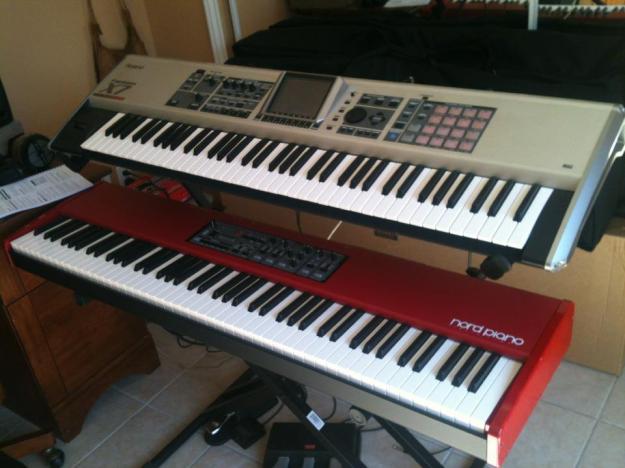
Rig Upgraded: Hello Nord, it's been long :-)

It’s been here for more than a week already, but I’m loving my Nord Piano more everyday. It has that “more-than-just-the-sum-of-its-parts” thing that characterizes a great instrument.

When the original NordLead came out, I was one of the first people in the Netherlands to buy one. It was my main axe (next to the MPC) and I loved it to bits. One night, after a long session at another studio, I took the train home and fell asleep. Upon reaching my stop, I woke up with a start and made a dash for the door just in the nick of time. Inexplicably, I did not realize I had left my NordLead on the train until the next day, when I needed it for a session at my home studio. I called the railways, only to find out that the train I had left it on was the international train to Paris…

I bought a NordLead 2 as a replacement, but had to sell it when I moved to Kenya in 2002. I always missed it, though, and kind of regretted not having held on to it.

Although I always dug the Rhodes sound of the Electro, I found it waaay too expensive for what it was, and the Stage didn’t change that opinion. But when this particular Nord Piano went up for sale, I decided to give it a try, even if I wasn’t in the market for one.

I originally wanted to get a Yamaha MO-X 8 as it seemed to meet all my requirements (except for aftertouch), but the more I played the more I disliked it. So I decided to pass on it, great value though it was

Although it was far more limited than what I thought I’d need, something about this NordPiano just convinced me to buy it. I don’t think would have pulled the trigger at its original retail price, but the seller gave me a reasonable price, and that sealed the deal.

As it turns out, I’m very happy with it!

Cinesamples Piano in Blue

test system: MacPro 2.66GHz (Nehalem), 12GB RAM, Avid Mbox3Pro, Cubase 5.5.3

The story is a captivating one: highly regarded sample-library makers Cinesamples got the opportunity to record a classic Steinway D, just hours before it was decommissioned. It was the piano used on Miles Davis’ classic “Kind of Blue” album and Glenn Gould’s “Goldberg Variations”, and Cinesamples managed to capture its sound and preserve it for posterity in the form of a Kontakt instrument.

I was just about to purchase Galaxy’s Vintage D, but when P.i.B. appeared on the radar I changed my mind last minute and got this instead. Cinesamples enjoys an enviable reputation as purveyors of high-quality sample libraries, so I had no doubt that this would be a fantastic instrument.

As it turns out, it is not. Rarely have my impulse buys turned out to be great investments, and this is no exception. But let’s start with the good stuff, because P.i.B. is not quite the trainwreck, either.

For starters, the sound is pretty good, if vintage vibe is your kind of thing. You can tell this is not a brand-new Japanese grand in an A-list concert hall, and that can be a good thing. PiB sounds intimate and smoky, and I can see how this would work great for film noir stuff.

There is three different mic positions: close, room and surround. Combining the first two options usually results in a rich and full sound. Adding the surround mics adds brightness, but not clarity. I find that all mic positions sound unimpressive in isolation, and some kind of blending is necessary.

I also like the GUI, it is well laid-out and easy to use; not always a given with Kontakt instruments. Changing velocity settings is straightforward and produces audibly different responses, and the included reverb is pretty good, too. However, I do wish devs would offer numerical value input in addition to virtual knob twisting.

Frankly, all the pieces for a great instrument are in place, which begs the question: where does it fall short?

To sum it up: playability. In all fairness, this is a highly subjective thing, and perhaps there are others who feel differently, but from what I have heard I am not alone with this assessment. For one, while the adjustable velocity response is great and effective, I have yet to find a setting that works for me. It is either not dynamic enough or way too much, with notes jumping out randomly.

Again, this may very well be a personal thing, but the inherent lag is not. Upon striking a key, there is a tiny hesitation that makes for a disconnected feel and playing experience. This not much of a problem at lower tempi or when you space out the notes, but for something a little more involved it just falls flat.

And although I mentioned that combining the close and room mics produces a rich and full sound, it also introduces a certain phasiness that I find unpleasant. The close mics in isolation sound bland, and the room mics in isolation reveal a room that really doesn’t sound all that great. You can disguise this with the included reverb, but I don’t really wanna go there.

Now, none of this stuff is beyond remedy. The instrument’s character is charmingly old-skool and it lends itself well for acoustic stuff (think double bass and brushes). If Cinesamples could tidy up the programming to address the lag and the velocity response I would like this a whole lot better. Here is hoping for a software update.

September 20, 2012 update:
v2 came out just last month and it would appear that they have addressed some of the concerns voiced in the review above. I updated yesterday and will report back soon.

Steinberg HalionSonic

Versions tested: 1.0.0 and 1.5.2
DAW: Cubase 5.5.1 and 5.5.3
computer: iMac 2.16 GHz Core2Duo, 3GB RAM
computer 2: MacPro 2.66 GHz Xeon W3520, 12GB RAM

When I first got this I thought it was a dud. But it’s not. It is actually really good. Okay, version 1.0.0 sucked, much too heavy on resources to be practical. But 1.2.x was better and 1.5.2 is just fine, if still somewhat heavier on the system than Kontakt 5 and even PLAY v3.

The list of stuff to like is long. First of all, thank you Steinberg/Yamaha for creating a VI that is not impossibly bloated; 12GB is still a very sizable amount of data, but compared to Goliath’s 40GB or Kontakt’s 50GB its footprint is positively dimunitive.

Another big “like” is the GUI. Anybody familiar with the basic layout of hardware workstation/samplers will have no problem getting used to HalionSonic. Every parameter I like to tweak is easy to find and adjust, and in spite of the multi-timbral layout it is possible to tailor the sound comprehensively before you even need to think about external processing.

The biggest “like”, however, are the sounds. Despite its relatively modest size, HalionSonic really takes the fight to Kontakt 5 and Goliath. Although they all have their strengths, I daresay that HalionSonic is the best all-rounder of the three, even though it is waaay cheaper than the other two!

For starters, it is the only one with decent acoustic piano sounds. No wait, they are more than just decent, they are really, really good! Unfortunately, the strong acoustic pianos are ultimately let down by unconvincing Rhodes sounds, which is weird as even Cubase’s stock EP’s work better for me. The other sounds all range from usable to surprisingly good, but the highlight (other than the acoustic pianos) for me has to be a wide range of fresh-sounding synth patches.

On the downside, while it is really nice of Steinberg to offer the 1.5 content update, it is unusable for me, as the installer will NOT let me install the content anywhere other than the “MacHD” system drive. I have all my sample libraries -including HalionSonic’s original content!- installed on a dedicated drive, but the 1.5 update installer inconveniently ignores this possibility. I upgraded to 1.5.2 and had to pass on the additional content, bummer. I really hope Steinberg is on the ball with this and that they will offer a fix soon. see update below

Finally, for the money it is simply a great deal. Considering that both Kontakt 5 and Goliath are significantly pricier (not to mention obese) I think Steinberg really has a very attractive proposition in HalionSonic. In fact, I like HS so much I am thinking of shelling out another $100 to upgrade to and see what Halion4 is all about. For those looking for a good all-round soundset, I can’t think of a better alternative.

update:
Piko (see comments) from Steinberg HQ sent me an email detailing how the content update CAN be installed on other hdd’s. It is actually very straightforward, and I am positively embarrassed that I did not figure that out myself. BUT: for Steinberg USA support to tell me that it is not possible is simply incompetent! Wake up, guys, learn your product.

Hello Linux

20111007-184341.jpg

After solving my Windows Vista64 problems, I decided to give Ubuntu 11 a try. Contrary to what I had been hearing on the net, the download and installation were absolutely painless. Ubuntu does take a bit of getting used to, but the installation was a lot faster and way more user-friendly than anything I have ever experienced with Windows.

The positives: This here Asus laptop came with WinV64, and the [function] keys don’t really work. For example, adjusting display brightness, volume control etc. have to be done with the trackpad and GUI.

However, with Ubuntu 11.04 it just works! Hold the [function] key and press the corresponding icon (F5-6 for display brightness, F11-12 for volume). Really a kick in Windows’ (or Asus?) face, considering this laptop came with WinV64 pre-installed.

I also like Ubuntu’s battery icon and power management better. Finally, it makes dual-booting easy for the layman enthusiast (me).

On the flip side: getting the hang of it is a different story. Maybe it just takes time, but for now I find WinV64 generally easier to use – except for the things noted above.

Nevertheless, considering Ubuntu is available for free, I would heartily recommend anyone with some spare hdd capacity to give it a try!

http://www.ubuntu.com/download

edit: another win for the linux team: fast and straightforward installation of HP network printer drivers.

A minor negative would be the aesthetics: I’m a Mac user and I find the Ubuntu GUI not the most pleasant to look at. I’ve downloaded a few different themes, but they don’t make much of a difference. It’s not a dealbreaker, though. It looks decent enough, just not great. I hope someone will develop a slicker GUI, as long as it is not detrimental to performance.

GARRITAN STEINWAY BASIC

Versions tested: 1.04
DAW: Cubase 4.5.2 and 5.5.1 and 5.5.3
computer: iMac 2.16 GHz Core2Duo, 3GB RAM
computer 2: MacPro 2.66 GHz Xeon W3520, 12GB RAM

This was an impulse buy. Garritan had just put this up on their site for $99 as a download and it was instant gratification that made me do it. I love being able to purchase and download right away.

Everything was straightforward and painless, from the paypal transaction to the 3+ GB download, from installation to activation (which requires a virtual keycard, a very elegant approach to anti-piracy). The whole process took less than 30 minutes and I was ready to play.

As Garritan states explicitly on their site, this instrument needs a weighted keyboard. With a semi-weighted action there isn’t much there. With my dirt-cheap Yamaha KX-8 controller the piano came to life.

The basic sound is very good, nicely recorded samples, with a warm and velvety character. This is great as most other digital offerings (software and hardware) tend to lean towards the brighter side, something that works well for pop and rock but isn’t always desirable for acoustic-oriented stuff.

A disadvantage is that this instrument sounds gentle and civilized all the time, it refuses to bark and growl when you really hit it fortissimo. But it works well for intimate stuff.

The user adjustability is somewhat limited, there is quite a few parameters but I can’t say they do a lot for the basic sound. The EQ is not bad, but I never use it. I do have the reverb on most of the time, but I usually replace it later on. Then there is the resonance, maybe my ears aren’t great but I don’t really hear it doing much, unless at extreme settings and that isn’t always a good thing.

An important ommission is lack of MIDI channel select, no big deal in a DAW, but it limits standalone functionality for live use.

Nevertheless, at $99 it is grrrrreat value, but Garritan has since raised the price to $149. Still not unreasonable, but no longer an absolute bargain. At $99 it competes directly with Alicia’s Keys and I would recommend it. As it is, I still like and use it a lot, but I’m not sure I’d give in to instant gratification at $149.

update
All Garritan Steinway products have been discontinued. Current owners can download the latest (64-bit compatiable) ARIA player to ensure compatibility with the latest hosts. Sad to see it go. I had been waiting on an upgrade path to the Pro version since 2010, but it never happened.

WinPC – AVS = better user experience

20110924-104421.jpg

My Asus/Vista64 laptop annoyed me. For some reason Firefox was unable to connect to the net. One day it just stopped working. After some mucking about I found out it was caused by some Anti-Virus Software that came with the computer.

I deactivated the AVS, installed Microsoft’s free Security Essentials and problem solved. This reinforces my belief that AVS is largely redundant if you exercise some caution. As a bonus, the computer runs much better now.

I still like my Macs better, but I don’t consider Windows Vista to be the suckfest it is generally made out to be.

TVC reel uploaded to youtube

When I lived in Kenya, I worked for the Sound & Picture Works Ltd. as a composer/sound designer/producer. The majority of our work was TV and radio advertisements, it was a great company to work for, there was a lot of variety in the assignments and I learned a lot there.

These clips are just a small selection of what I did there. Hope you enjoy!

METEN MET TWEE MATEN

Vanochtend is Geert Wilders door de Amsterdamse rechtbank op alle punten vrijgesproken. De zaak is al dusdanig breed uitgelicht in de media dat ik niet de behoefte heb om het hier allemaal nog eens te gaan herkauwen, maar laat ik voorop stellen dat ik het eens ben met het vonnis.

Het was een schertsproces dat uiteindelijk alleen maar gratis publiciteit voor de PVV heeft opgeleverd. Dus Wilders is alweer de winnaar. Hier gaat hij mee scoren, reken maar.

En toch ben ik het ook niet eens met het vonnis. Niet omdat ik vind dat Wilders veroordeeld moet worden voor belachelijk flodderwerk zoals Fitna, laat die man lekker zijn gang gaan.

Maar wel omdat sinds 1995 het ontkennen van de Holocaust in Nederland officieel strafbaar is. De Hoge Raad oordeelde toen (in de zaak tegen Siegfried Verbeke) dat het ontkennen van de Holocaust wel onder het discriminatieverbod valt.

Ik was hiervan nooit op de hoogte totdat vorige maand een lezing georganiseerd door een Amsterdamse student op het laatste moment werd afgelast omdat de uitgenodigde Britse spreker bekend stond als een zogenaamde Holocaust-revisionist. De Amsterdamse burgemeester Van Der Laan vond dat dit debat zelfs niet in de prive-sfeer gevoerd mocht worden omdat dat kwetsend zou zijn voor de Joodse medeburgers.

Pardon?

We kunnen in Nederland dus ongestraft idiote films vol opruiende anti-Islam propaganda maken, maar in de prive-sfeer kritisch over de Holocaust praten is strafbaar?

De uitspraak van vandaag illustreert treffend de hypocrisie van de hedendaagse Nederlandse samenleving. Zolang we het maatschappelijk debat als excuus gebruiken kunnen we zonder pardon allerlei grievende onzin over onze Islamitische landgenoten de media in spuien, maar bijna 70 jaar na de Tweede Wereldoorlog zijn de Joodse medeburgers nog altijd te kwetsbaar en gevoelig om een debat over de Holocaust aan te kunnen?

Zie hier de tolerantie waar Nederland zich altijd zo graag op laat voorstaan.

Als er een advocaat is die tijd en zin heeft om de beslissing van de Hoge Raad uit 1995 aan te vechten, dan houd ik mij van harte aanbevolen.