Category Archives: ENGLISH

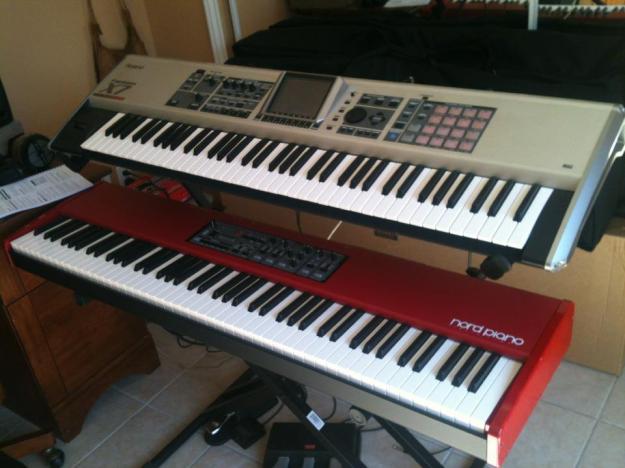
Rig Upgraded: Hello Nord, it's been long :-)

It’s been here for more than a week already, but I’m loving my Nord Piano more everyday. It has that “more-than-just-the-sum-of-its-parts” thing that characterizes a great instrument.

When the original NordLead came out, I was one of the first people in the Netherlands to buy one. It was my main axe (next to the MPC) and I loved it to bits. One night, after a long session at another studio, I took the train home and fell asleep. Upon reaching my stop, I woke up with a start and made a dash for the door just in the nick of time. Inexplicably, I did not realize I had left my NordLead on the train until the next day, when I needed it for a session at my home studio. I called the railways, only to find out that the train I had left it on was the international train to Paris…

I bought a NordLead 2 as a replacement, but had to sell it when I moved to Kenya in 2002. I always missed it, though, and kind of regretted not having held on to it.

Although I always dug the Rhodes sound of the Electro, I found it waaay too expensive for what it was, and the Stage didn’t change that opinion. But when this particular Nord Piano went up for sale, I decided to give it a try, even if I wasn’t in the market for one.

I originally wanted to get a Yamaha MO-X 8 as it seemed to meet all my requirements (except for aftertouch), but the more I played the more I disliked it. So I decided to pass on it, great value though it was

Although it was far more limited than what I thought I’d need, something about this NordPiano just convinced me to buy it. I don’t think would have pulled the trigger at its original retail price, but the seller gave me a reasonable price, and that sealed the deal.

As it turns out, I’m very happy with it!

Cinesamples Piano in Blue

test system: MacPro 2.66GHz (Nehalem), 12GB RAM, Avid Mbox3Pro, Cubase 5.5.3

The story is a captivating one: highly regarded sample-library makers Cinesamples got the opportunity to record a classic Steinway D, just hours before it was decommissioned. It was the piano used on Miles Davis’ classic “Kind of Blue” album and Glenn Gould’s “Goldberg Variations”, and Cinesamples managed to capture its sound and preserve it for posterity in the form of a Kontakt instrument.

I was just about to purchase Galaxy’s Vintage D, but when P.i.B. appeared on the radar I changed my mind last minute and got this instead. Cinesamples enjoys an enviable reputation as purveyors of high-quality sample libraries, so I had no doubt that this would be a fantastic instrument.

As it turns out, it is not. Rarely have my impulse buys turned out to be great investments, and this is no exception. But let’s start with the good stuff, because P.i.B. is not quite the trainwreck, either.

For starters, the sound is pretty good, if vintage vibe is your kind of thing. You can tell this is not a brand-new Japanese grand in an A-list concert hall, and that can be a good thing. PiB sounds intimate and smoky, and I can see how this would work great for film noir stuff.

There is three different mic positions: close, room and surround. Combining the first two options usually results in a rich and full sound. Adding the surround mics adds brightness, but not clarity. I find that all mic positions sound unimpressive in isolation, and some kind of blending is necessary.

I also like the GUI, it is well laid-out and easy to use; not always a given with Kontakt instruments. Changing velocity settings is straightforward and produces audibly different responses, and the included reverb is pretty good, too. However, I do wish devs would offer numerical value input in addition to virtual knob twisting.

Frankly, all the pieces for a great instrument are in place, which begs the question: where does it fall short?

To sum it up: playability. In all fairness, this is a highly subjective thing, and perhaps there are others who feel differently, but from what I have heard I am not alone with this assessment. For one, while the adjustable velocity response is great and effective, I have yet to find a setting that works for me. It is either not dynamic enough or way too much, with notes jumping out randomly.

Again, this may very well be a personal thing, but the inherent lag is not. Upon striking a key, there is a tiny hesitation that makes for a disconnected feel and playing experience. This not much of a problem at lower tempi or when you space out the notes, but for something a little more involved it just falls flat.

And although I mentioned that combining the close and room mics produces a rich and full sound, it also introduces a certain phasiness that I find unpleasant. The close mics in isolation sound bland, and the room mics in isolation reveal a room that really doesn’t sound all that great. You can disguise this with the included reverb, but I don’t really wanna go there.

Now, none of this stuff is beyond remedy. The instrument’s character is charmingly old-skool and it lends itself well for acoustic stuff (think double bass and brushes). If Cinesamples could tidy up the programming to address the lag and the velocity response I would like this a whole lot better. Here is hoping for a software update.

September 20, 2012 update:
v2 came out just last month and it would appear that they have addressed some of the concerns voiced in the review above. I updated yesterday and will report back soon.

Steinberg HalionSonic

Versions tested: 1.0.0 and 1.5.2
DAW: Cubase 5.5.1 and 5.5.3
computer: iMac 2.16 GHz Core2Duo, 3GB RAM
computer 2: MacPro 2.66 GHz Xeon W3520, 12GB RAM

When I first got this I thought it was a dud. But it’s not. It is actually really good. Okay, version 1.0.0 sucked, much too heavy on resources to be practical. But 1.2.x was better and 1.5.2 is just fine, if still somewhat heavier on the system than Kontakt 5 and even PLAY v3.

The list of stuff to like is long. First of all, thank you Steinberg/Yamaha for creating a VI that is not impossibly bloated; 12GB is still a very sizable amount of data, but compared to Goliath’s 40GB or Kontakt’s 50GB its footprint is positively dimunitive.

Another big “like” is the GUI. Anybody familiar with the basic layout of hardware workstation/samplers will have no problem getting used to HalionSonic. Every parameter I like to tweak is easy to find and adjust, and in spite of the multi-timbral layout it is possible to tailor the sound comprehensively before you even need to think about external processing.

The biggest “like”, however, are the sounds. Despite its relatively modest size, HalionSonic really takes the fight to Kontakt 5 and Goliath. Although they all have their strengths, I daresay that HalionSonic is the best all-rounder of the three, even though it is waaay cheaper than the other two!

For starters, it is the only one with decent acoustic piano sounds. No wait, they are more than just decent, they are really, really good! Unfortunately, the strong acoustic pianos are ultimately let down by unconvincing Rhodes sounds, which is weird as even Cubase’s stock EP’s work better for me. The other sounds all range from usable to surprisingly good, but the highlight (other than the acoustic pianos) for me has to be a wide range of fresh-sounding synth patches.

On the downside, while it is really nice of Steinberg to offer the 1.5 content update, it is unusable for me, as the installer will NOT let me install the content anywhere other than the “MacHD” system drive. I have all my sample libraries -including HalionSonic’s original content!- installed on a dedicated drive, but the 1.5 update installer inconveniently ignores this possibility. I upgraded to 1.5.2 and had to pass on the additional content, bummer. I really hope Steinberg is on the ball with this and that they will offer a fix soon. see update below

Finally, for the money it is simply a great deal. Considering that both Kontakt 5 and Goliath are significantly pricier (not to mention obese) I think Steinberg really has a very attractive proposition in HalionSonic. In fact, I like HS so much I am thinking of shelling out another $100 to upgrade to and see what Halion4 is all about. For those looking for a good all-round soundset, I can’t think of a better alternative.

update:
Piko (see comments) from Steinberg HQ sent me an email detailing how the content update CAN be installed on other hdd’s. It is actually very straightforward, and I am positively embarrassed that I did not figure that out myself. BUT: for Steinberg USA support to tell me that it is not possible is simply incompetent! Wake up, guys, learn your product.

Hello Linux

20111007-184341.jpg

After solving my Windows Vista64 problems, I decided to give Ubuntu 11 a try. Contrary to what I had been hearing on the net, the download and installation were absolutely painless. Ubuntu does take a bit of getting used to, but the installation was a lot faster and way more user-friendly than anything I have ever experienced with Windows.

The positives: This here Asus laptop came with WinV64, and the [function] keys don’t really work. For example, adjusting display brightness, volume control etc. have to be done with the trackpad and GUI.

However, with Ubuntu 11.04 it just works! Hold the [function] key and press the corresponding icon (F5-6 for display brightness, F11-12 for volume). Really a kick in Windows’ (or Asus?) face, considering this laptop came with WinV64 pre-installed.

I also like Ubuntu’s battery icon and power management better. Finally, it makes dual-booting easy for the layman enthusiast (me).

On the flip side: getting the hang of it is a different story. Maybe it just takes time, but for now I find WinV64 generally easier to use – except for the things noted above.

Nevertheless, considering Ubuntu is available for free, I would heartily recommend anyone with some spare hdd capacity to give it a try!

http://www.ubuntu.com/download

edit: another win for the linux team: fast and straightforward installation of HP network printer drivers.

A minor negative would be the aesthetics: I’m a Mac user and I find the Ubuntu GUI not the most pleasant to look at. I’ve downloaded a few different themes, but they don’t make much of a difference. It’s not a dealbreaker, though. It looks decent enough, just not great. I hope someone will develop a slicker GUI, as long as it is not detrimental to performance.

GARRITAN STEINWAY BASIC

Versions tested: 1.04
DAW: Cubase 4.5.2 and 5.5.1 and 5.5.3
computer: iMac 2.16 GHz Core2Duo, 3GB RAM
computer 2: MacPro 2.66 GHz Xeon W3520, 12GB RAM

This was an impulse buy. Garritan had just put this up on their site for $99 as a download and it was instant gratification that made me do it. I love being able to purchase and download right away.

Everything was straightforward and painless, from the paypal transaction to the 3+ GB download, from installation to activation (which requires a virtual keycard, a very elegant approach to anti-piracy). The whole process took less than 30 minutes and I was ready to play.

As Garritan states explicitly on their site, this instrument needs a weighted keyboard. With a semi-weighted action there isn’t much there. With my dirt-cheap Yamaha KX-8 controller the piano came to life.

The basic sound is very good, nicely recorded samples, with a warm and velvety character. This is great as most other digital offerings (software and hardware) tend to lean towards the brighter side, something that works well for pop and rock but isn’t always desirable for acoustic-oriented stuff.

A disadvantage is that this instrument sounds gentle and civilized all the time, it refuses to bark and growl when you really hit it fortissimo. But it works well for intimate stuff.

The user adjustability is somewhat limited, there is quite a few parameters but I can’t say they do a lot for the basic sound. The EQ is not bad, but I never use it. I do have the reverb on most of the time, but I usually replace it later on. Then there is the resonance, maybe my ears aren’t great but I don’t really hear it doing much, unless at extreme settings and that isn’t always a good thing.

An important ommission is lack of MIDI channel select, no big deal in a DAW, but it limits standalone functionality for live use.

Nevertheless, at $99 it is grrrrreat value, but Garritan has since raised the price to $149. Still not unreasonable, but no longer an absolute bargain. At $99 it competes directly with Alicia’s Keys and I would recommend it. As it is, I still like and use it a lot, but I’m not sure I’d give in to instant gratification at $149.

update
All Garritan Steinway products have been discontinued. Current owners can download the latest (64-bit compatiable) ARIA player to ensure compatibility with the latest hosts. Sad to see it go. I had been waiting on an upgrade path to the Pro version since 2010, but it never happened.

WinPC – AVS = better user experience

20110924-104421.jpg

My Asus/Vista64 laptop annoyed me. For some reason Firefox was unable to connect to the net. One day it just stopped working. After some mucking about I found out it was caused by some Anti-Virus Software that came with the computer.

I deactivated the AVS, installed Microsoft’s free Security Essentials and problem solved. This reinforces my belief that AVS is largely redundant if you exercise some caution. As a bonus, the computer runs much better now.

I still like my Macs better, but I don’t consider Windows Vista to be the suckfest it is generally made out to be.

FOCUSRITE SAFFIRE LE

This is going to be one short review. There really isn’t much too say about the Saffire LE. It does the job it is supposed to do just fine, sounds decent and requires very little attention or care.

Earlier drivers were not as solid as the current one, with occasional glitches, but nowadays it is stable and reliable; the only quirk I encounter every now and then is that it fails to sync up when the computer comes out of sleep mode (or restart) but that does not happen often and dis- and reconnecting the cable takes care of that.

Within Cubase I normally have the buffer on 256 samples as that is the sweet spot for my aging iMac, but I have used the LE at 128 without problems. Sharing the firewire buss with other devices is a mixed bag, it worked fine with an Iomega HDD but with a WD Mybook not so much.

The mic preamps do the job, but no more than that. To me that is the LE’s weakest link, you’ll get the signal but it is a little thin and when you hit the limit things sound nasty. Line levels are slightly low, too. That could be the price you pay for a buss-powered device. Connectivity is good, though, and the software control panel/mixer is easy to understand and adjust.

This box is never going to win any awards, it is unassuming and not anything special. But it does not get in the way of you and the music and facilitates the recording process well enough.

For the money you can’t complain for what you get. Nothing is great, but everything works well. A good first audio IO for people on a budget. Nice.

edit:
As an afterthought: I suspect that this unit is really an M-Audio interface disguised as a Focusrite. when I check the system processes in OSX’ Activity Monitor there is only an M-Audio firmware root process, and I don’t own or have connected any of their stuff.

SUM OF PARTS


I use an Apple computer. According to internet lore (perpetuated by the Windows protagonists, no doubt) this makes me a fanboi, an idiot who drank the Kool Aid and bought into the Apple hype. I am being exploited and have to pay “Apple tax” (on hardware that is apparently up to 50% cheaper when bought from newegg.com) just because of a pretty box. That’s all there is to it, case closed.

In fact, my decision to get a Mac was a fairly rational one. Although I have always had PC’s, I worked on Macs professionally and came to appreciate the platform for what it is. But not enough to justify the higher sticker price, so when I was ready for a new computer I had made up my mind and was going to buy a custom-built Windows laptop, made by a small company who specializes in audio PC’s.

I chose mobility over performance, as I knew I would not be stationary for too long. I did eyeball the MacBookPros but could not afford it, so I ordered a Windows laptop for about EUR 1700. This was in 2007. A few days later, I passed by the Apple Store and considered the iMacs. They looked portable. Had better hardware specs than the Windows laptop I just ordered. And cost about the same.

Most importantly, a nifty feature called Bootcamp was on the way. Still in a beta phase, but acquaintances told me it worked fine on their machines. So for the same money I get a big screen computer that runs both platforms, is semi-portable and has better performance to boot? Done. I cancelled the laptop order and bought an iMac.

Happy camping is the result. Portability is real thanks to an iLugger. And Bootcamp works as advertised, so I made a partition with WindowsXP for the –ahem- “evaluation” software and games. I would habitually start projects in my officially purchased copy of Cubase (OSX), and finish them in WinXP where I had access to software that I wouldn’t have been able to buy.

But the weirdest thing happened. I gradually stopped using the cracked software because I could not be bothered to reboot into WinXP everytime. Long story short, nowadays I stay in OSX and use only legit software. Windows is reserved for the occasional game.

I don’t hate Windows. It is undeniably more volatile and vulnerable, but with common sense and a bit of caution you really need not worry too much. I hear good things about Win7 and if Apple does not offer better bang-for-buck in the next MacPro my next computer may well be a custom-built rackmount PC.

I’d miss OSX, though. There is quite a bit of anecdotal evidence on the net suggesting that Win7 may actually outperform OSX in many respects. I believe it, but I don’t care. If true, I’d happily take a performance hit for the hassle-free and relaxing work environment that is OSX.

If numbers are all that matters, there is no doubt. Get a Windows PC, save $$$ and get the job done. Strictly speaking, nobody needs plants in their office. Or framed photos of their loved ones. For all the blah blah, you could work in a cardboard box and still do your job.

So why do people put plants in their office and photos on their desk? Some call it Feng Shui (google/wiki it if you don’t know what it means). For many if not most people a sense of aesthetics helps them get through the day and be more productive.

It’s the same for me with OSX. I find it a pleasing and even soothing work environment. And Apple’s integration of hardware and software also guarantuees a more stable and reliable platform: indeed, my aging iMac is the best Windows machine I have ever owned!

I’ve schlepped it with me through airport security on three different continents, had it involuntarily stress-tested in the trunk of many a car on unpaved backroads and it has held up nicely, touch wood.

My only concern is that Apple’s success in the consumer electronics market has shifted their focus away from professional computing, and it remains to be seen if they can continue to cater to the needs of a relatively small (but loyal) niche market. The discontinuance of the Xserve and retarding update cycle of the MacPro do not bode well in this regard.

I hope they stay committed to what was once their core business, for Apple offers something unique in the ever-competitive world of computing: a product that is truly greater than the sum of its parts.

KRK RP5G2 & RP8G2


I used to own a pair of RP8G2’s a few years ago, and now I have a pair of RP5G2’s as secondary speakers. I like both of them, but there are a number of caveats.

First of all, the RP8G2’s are incredibly bassy, and this is greatly augmented when you place them on resonant surfaces (like a desk). When you have them on proper speaker stands away from the wall, it is not so bad and you could actually mix on them if you take the time to get to know them. But they are still bass-heavy and you have to allow for that when making mix decisions, which is -of course- not ideal. When placed on a desk and/or near a wall, they are only good for non-critical listening. But they are great for parties, as they go loud and sound good for most modern music.

I like the RP5G2’s much better. When used as nearfields they have enough low end for most styles except for really bass-heavy styles like Hiphop/R&B or EDM. They are also not as sensitive to placement as the 8’s. Downside of the smaller woofers is that they start to choke when pushed, they don’t go very loud. But you could get a reasonable mix balance on these, provided you listen at moderate levels and have something else to check the lowest octave or so with.

I would not call either of them neutral sounding. They actually sound a little polished and they are somewhat short on detail. My biggest beef with them (more so with the 8’s than the 5’s) is that they are a little fatiguing, especially over prolonged periods of time and louder levels. The 5’s do not go that loud so this is not as much of a problem with them, but it is definitely a part of the series’ character.

I somehow wonder whether the RP6G2 would be the sweet spot of the series? The 8’s are too bassy, the 5’s are too light and don’t go loud enough…

But with all that said, I think they are as good as it gets at their respective price points. The obvious competitors are the Yamaha HS and M-Audio BX series. Between these series it is really just a matter of taste as they are all competent stuff for the money. I went with the KRK’s because they sound a little more hi-fi. The Yamahas have a more forward “monitor” sound but lack depth. the M-Audio BX8 sounds similar to the KRK RP8G2 whereas the BX5 is -oddly- closer to the Yamaha HS50.

If you are looking for something on a budget, they are all good choices, so check them out (preferably in your own room) and get whatever works best for you. I do recommend to upgrade to better (but pricier) speakers as soon as you can afford it, though. These speakers do the job, but none of them will give you enough detail.

edit (September 24, 2011):
Thanks all for the comments. I kind of want to backtrack on the “fatiguing” statement. It was definitely an issue for me on the 8’s, but I have used the 5’s on an almost daily basis over the last few weeks and it hasn’t been a problem.

EASTWEST QUANTUM LEAP GOLIATH

Versions tested: PLAY 1.2.5 and 2.1.1 and 3.0.21
DAW: Cubase 4.5.2 and 5.5.1 and 5.5.3
computer: iMac 2.16 GHz Core2Duo, 3GB RAM
computer 2: MacPro 2.66 GHz Xeon W3520, 12GB RAM

INSTALLATION
I bought Goliath for $250 (including iLok + shipping) about one year ago when Soundsonline had one of their many 50% off deals. The package arrived promptly and I was brimming with anticipation, thanks to rave reviews and EW’s reputation for great sound.

The install took about two hours (6 DVD’s totalling 40GB) and required registering the iLok etc. For some reason the authorization failed and I was unable to use it. Thankfully, EastWest’s e-mail support swiftly replied, they uploaded the auhorization code to my iLok account and I was good to go. Or so I thought.

I started my DAW (Cubase 4.5.2 at the time) to immerse myself in some serious sound exploration, but when I opened an instance of PLAY (Goliath’s engine) Cubase “unexpectedly quit”. After several unsuccessful attempts I tried PLAY in stand-alone mode but fared no better. I managed to open the application but loading sounds would cause it to crash.

Again, EW support was most helpful. They always replied e-mails within 24 hours and did point me to the solution eventually, which turned out to be an updated version of Yamaha Studio Manager. It required some back-and-forth, reinstalling and updating but the issue was resolved so now I could finally go and get inspired.

SOUND
I have to say that I was not that impressed. Perhaps I expected too much but I found that Goliath is a few miles short of being the all-purpose workhorse it wants to be.

Let’s start with the positives. I like EW’s warm signature sound. The orchestral stuff is definitely a step up from other all-in-ones or hardware workstations, and the included reverb sounds great. The choirs and solo voices are wonderful, too.
Acoustic guitars sound very nice, there is a fairly realistic Lakland bass, decent acoustic drumkits, and some nice pad-like patches. Percussion sounds great too, as do many of the ethnic instruments.

The electronic drumkits are a mixed bag, with some of the sounds really knocking and some others sounding dated.

On to the negatives, with the undisputed #1 being the acoustic pianos. They suck. Really. This bit on the soundsonline site correctly states

“GOLIATH includes the entire 32 Gigabytes of content from Future Music magazine’s VIRTUAL INSTRUMENT OF THE YEAR – COLOSSUS, PLUS an additional 8 Gigabytes of new content from the latest EASTWEST/QUANTUM LEAP collections, including the Sound On Sound magazine 5 STAR awarded EASTWEST/PMI BOSENDORFER 290 PIANO”

which I find misleading as it had me believe that a stripped-down version of their QL Piano was included. Not so.

Perhaps there was a time that the PMI Bosendorfer could be considered great, but it certainly is not now. My hardware keyboards sound better and feel more like instruments, as does the $99 Garritan Steinway Basic.
Likewise, the Rhodes is pathetic. Maybe someone else could find a use for it, but not me, and I have tried. Clavinets fare no better, and Goliath’s only saving grace for keyboardists is the B3, which is pretty good to my ears.

The synthesizer section is mediocre. The aforementioned pad-like patches are fine, but the analog emulations are a waste of space. They could work for some non-critical parts, but PLAY’s inflexible engine and lack of tweakability really kill it as a synth.

PERFORMANCE
I have to say I like the GUI’s looks, but there are some ergonomic flaws. For example, the fact that you can’t input numeric values makes it hard to copy settings.

What’s more, on my machine (an aging 2.16GHz Core2Duo iMac with 2GB RAM, but well above minimum sys reqs) performance was unreliable, and I found that I had to bounce every instance right after creating the part.
Multi-timbrality is a no-go area, which is acknowledged sotto voce by EW as they recommend not to use it and open multiple instances instead.

In both standalone and VST mode I occasionally encounter the following problem: when I load and replace sounds frequently (like when I’m auditioning sounds for a part) some sort of high latency is introduced and it becomes unplayable. Only quitting the instance (or application in standalone) and reopening it resolves this issue.

On the upside, when I upgraded to Cubase 5.5.1 PLAY’s performance improved. It is pretty stable now, and appears to run a little leaner, too. After a few months of hassle-free operation I took the plunge and upgraded to PLAY 2.1.1

Maybe I should not have, because it immediately ‘unexpectedly quit’ Cubase again. It works for the most part, though, and the GUI looks a little better.

CONCLUSION
All in all, I am reasonably content with Goliath because I got a good deal, but I would not recommend it. It is not the allrounder EW claims it is and the PLAY engine hasn’t worked all that great on my machine. There are some sounds that I really like and use frequently, but the rest is just sitting there clogging up the hard drive. Had I paid the full amount for it, I would have felt royally screwed.

To be competitive it should be priced at $150-200, work flawlessly and have a smaller GB footprint. To be fair, other users may not have encountered these problems, but if the reports on the net are anything to go by, mine is not an isolated incident.

EW’s minimum system requirements are a G5 1.6GHz, 2GB RAM, Mac OS 10.4 or newer. I find that hard to believe. In my experience, you’d need at least double the RAM, a dedicated harddisk and waaay more CPU power. My computer hits the ceiling when I play 5 simultaneous voices with one of the choir sounds.

All this notwithstanding, Goliath has got me wishing for more of EW’s orchestral and acoustic stuff. A new computer should arrive this summer and if PLAY performs better on it, I might just want to give the Composer’s collection another look.

edit (September 24, 2011):

I installed PLAY 3.0.21 and it really makes a difference. Although my gripes with the UI have not been addressed, it is a major improvement in terms of stability and efficiency.
To give you an idea of the efficiency, it now runs leaner within Cubase 5.5.3 than Steinberg’s own HalionSonic, go figure.

I thought it would be fair to post this in light of the criticisms I have spouted above.